“Digital tools to strengthen communication between citizens from the Danube countries”
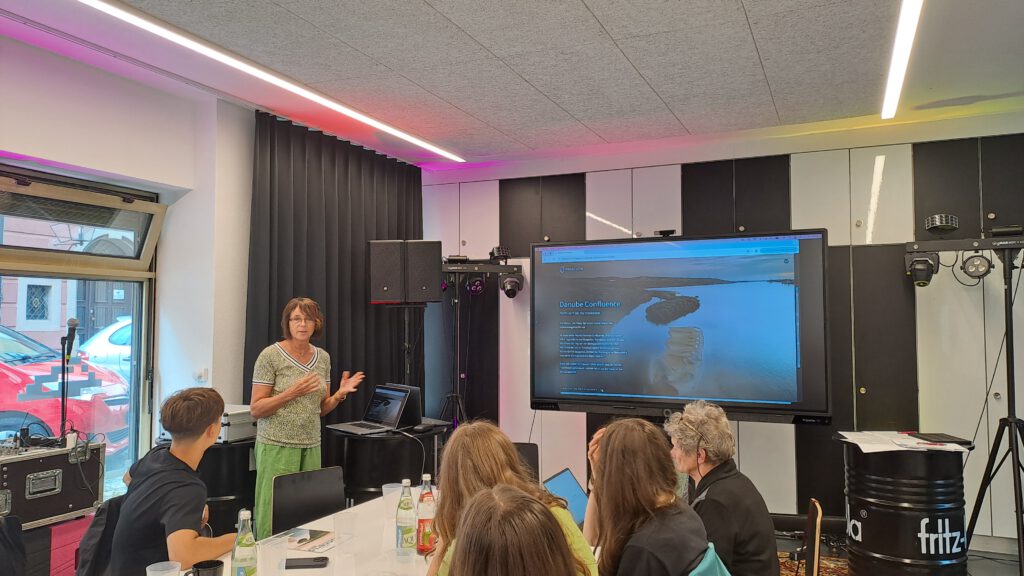
On the first day of the workshop, 22 July 2025, Sabine Geller introduced the participants to the topic of ‘storytelling techniques’ using the practical example of ‘Danube Confluence’. She explained how important it is to include detailed shots, to have a central theme in the interview as a point of orientation and to loosen up the content, for example with a funny question. The participants worked in five small groups and prepared their own interviews. Each group consisted of three to four people and represented the three nationalities. They researched their interview partners, collected person-specific questions and recorded some practice clips. The interviewees were Martin Ansbacher (Lord Mayor of Ulm), Carmen Stadelhofer (president of ILEU e.V.), Jana Pulli (federal volunteer from the Ulm Family Education Centre), Petra Schmitz (Managing Director of Local Agenda Ulm) and Helena Miller (member of ‘Die Grünen’ and Fridays for future). All of them are professionally or through their commitment connected to one or more SDGs, e.g. ‘4: Quality of education’ or ‘13: Climate action’. In the afternoon, the small groups interviewed their respective partners and shot close-ups of their workplaces. These recordings formed the basis for the next part of the workshop. Presentation in English Presentation in German
Actionbound Preparation Meeting Summary
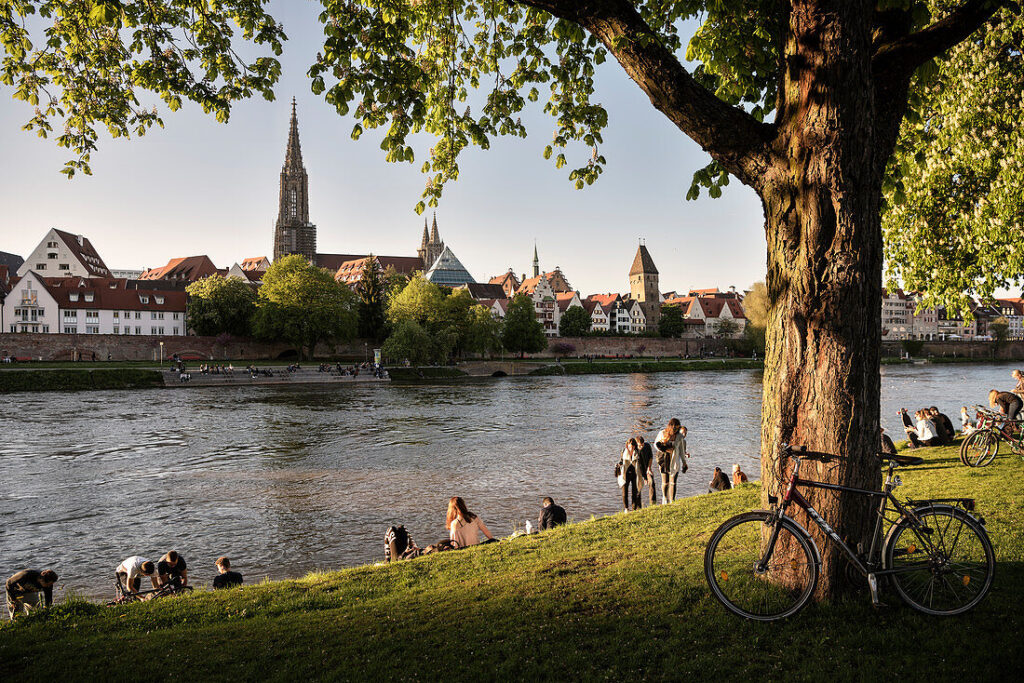
Date: Thursday, July 10, 2025Time: 18:00 – 19:30Participants: 21 international and local students, teachers, and project coordinators The meeting opened with a round of introductions and confirmation that all students had already connected with their host families and were in contact with their German peers. An overview of the upcoming exchange week in Ulm was provided, including planned activities and cultural experiences. Students were introduced to two key themes: storytelling and video creation. A specialist introduced the concept of digital storytelling, highlighting its importance in creating engaging and informative content through visual and narrative techniques. Practical advice was given on structuring interviews, gathering footage, and using editing tools. Another session focused on video production, with emphasis on planning, collecting sufficient material, and crafting a message. Students were encouraged to explore tools like Canva and CapCut and were provided with example links and tutorials. Logistical points were discussed: Suggestions for activities during Ulm’s Schwörwoche, including sports and festivals, were welcomed. Group organization and a shared online group for communication will follow soon. The session concluded with open questions, a final reminder to submit Germany ticket bookings, and confirmation that address information will be provided in Latin script.
Successful Kick-Off for ELEVATE Project in Sevnica, Slovenia
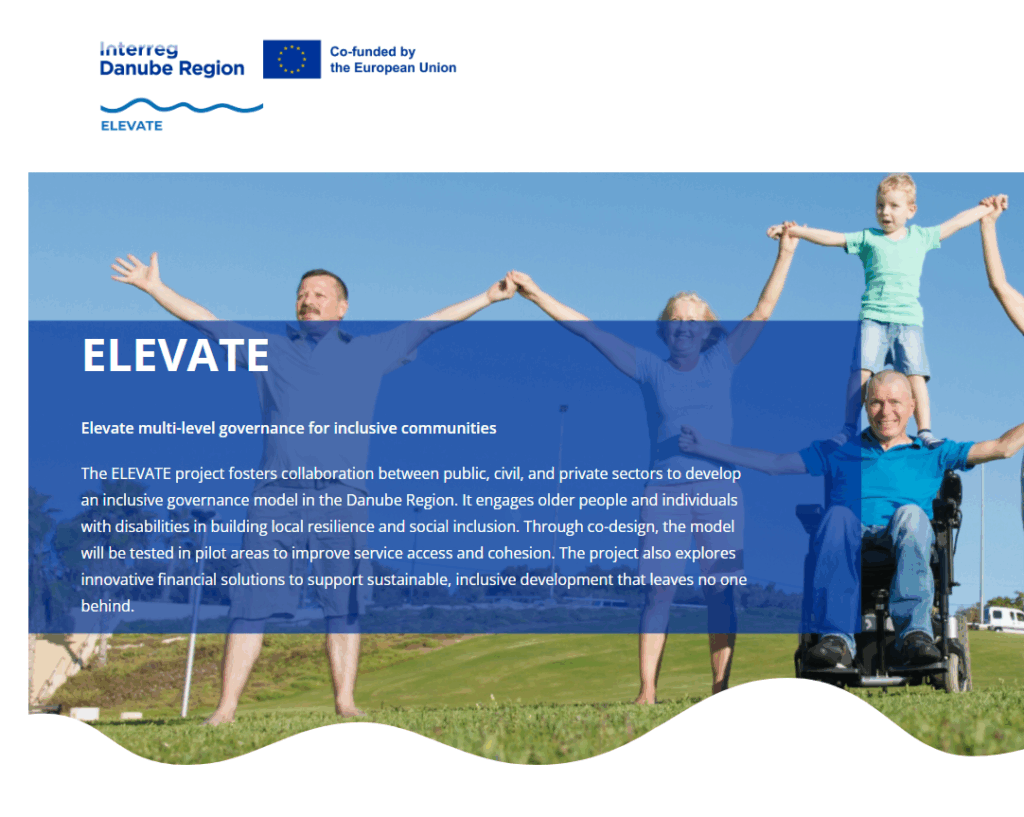
On May 6–7, 2025, the new EU-funded ELEVATE project officially launched with a two-day kick-off meeting in Sevnica, Slovenia. Supported by the Interreg Danube Programme, the three-year project brings together 17 project partners and 13 strategic associated partners from across the Danube Region — including ILEU e.V. from Ulm, Germany. ELEVATE aims to strengthen collaboration among public, civil, and private sectors to develop inclusive governance models. A key focus is on engaging older people and persons with disabilities in shaping resilient and inclusive local communities. Through a co-design process, pilot regions will test new approaches to improve access to services and foster social cohesion. The meeting included partner presentations, planning workshops, and a study visit to local best-practice initiatives, such as the intergenerational center Posavje+ and the “Sopotniki” transportation program for elderly citizens. These inspiring examples set the tone for collaboration and learning throughout the project’s duration. Press release english Pressemitteilung deutsch More information about the project: https://interreg-danube.eu/projects/elevate
98. Come together Session 22.06.25
Dear colleagues and friends from the Danube region and other European countries We cordially invite you to the 98th international session by Videoconferencing: Come together! Connecting people by culture! Time and date: Sunday, 22.06.2025, 6:30 p.m. (CET), in some of your countries 7:30 p.m., in other ones 5:30 p.m. This session will be moderated by Carmen Stadelhofer (ILEU e.V.) and Emiliya Velikova Language: The event will be held in English, with translation into Bulgarian, Romanian and German if needed. For organizational reasons, we kindly ask you to confirm your participation and let us know if you require translation. Access to the session: Danube Networkers invite: Come Together – Connecting people by culture! https://us02web.zoom.us/j/88667915552?pwd=RGxOMnRkd0lXQWpsTm83bHZoVmJCZz09 Meeting-ID: 886 6791 5552 Kenncode: 569068
Online Lecture with Prof. Dr. Brigitte Geißel, “Democracy as Self-Government – Democratic Innovations by and with Citizens”
The event will be held in English, with translation into Bulgarian, Romanian, Serbian and German if needed. For organizational reasons, we kindly ask you to confirm your participation and let us know if you require translation. Invitation: Lecture on “Democracy as Self-Government” with Prof. Dr. Brigitte Geißel – 15 July, 6:00 p.m. (CET) Dear colleagues and friends from the Danube Region and other European countries, We warmly invite you to our next online event in the frame of the “Fit4Democracy” project: “Democracy as Self-Government – Democratic Innovations by and with Citizens” with Prof. Dr. Brigitte Geißel, Institute for Political Science, Goethe University Frankfurt on Monday, 15 July 2025, at 6:00 p.m. (CET) via Zoom. Starting from the premise that the future of democracy needs to be reimagined, in this lecture, Prof. Dr. Brigitte Geißel will present an innovative approach that places citizens at the center of democratic processes. She argues that people should decide for themselves how they want to be governed (Read more here). The talk will be supported by theoretical foundations, empirical insights, and examples from other countries. Additionally, Prof. Geißel will present and discuss ideas for procedures and practices that empower citizens and communities to shape their own democratic visions. Prof. Dr. Geißel’s ideas on democratic innovations and citizen participation align well with our project, as they support the development of new, citizen-centered democratic approaches beyond traditional structures. We are therefore very happy to welcome her as a speaker. You can join the meeting via this link: https://us02web.zoom.us/j/88591526817?pwd=USDPgvYSjeeszKYqMCIFf3XoaHU4Zh.1 Meeting-ID: 885 9152 6817Kenncode: 752799 The event will be held in English, with translation into Bulgarian, Romanian, Serbian and German if needed. For organizational reasons, we kindly ask you to confirm your participation and let us know if you require translation. For all questions and suggestions, feel free to reach out to us anytime at: democracy@ileu.net We look forward to your participation and to an inspiring discussion! Warm regards, on behalf of the ILEU team
Join our photocampaign “Stand up for Europe and Democracy” – A Sign of Unity
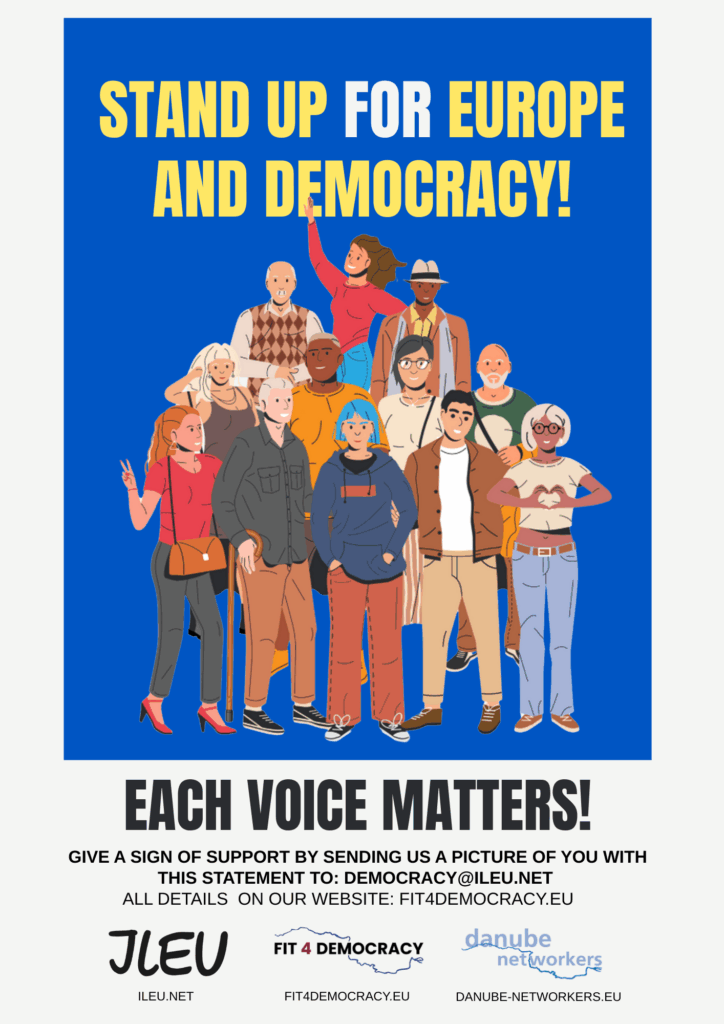
A Call for Participation in frame of the Fit 4 Democracy Project Welcome to our project! With our Photo campaign “I stand up for Europe and democracy”, which started on September 15, we want to bring people together, that are willing to stand up for the values of a united, diverse, and peaceful Europe. It`s easy to take part! Just print out our postcard, take a photo of yourself alone, or with others holding the flyer and send it to democracy@ileu.net ! You can send your photo in portrait or landscape format, both are fine! We will collect a digital mosaic with the photos, as we did in the project “Bread Connects – Give a Sign of Friendship”, which you can see here. By sending your Photo to democracy@ileu.net, you authorise us to put the photo with your name(s) on this Website along with other contributions from people from Germany and many other countries. If other people are visible in your photo, you are responsible to make sure that they also agree to the terms and conditions before sending the photo to us. This flyer is available in different languages, which you can find here. Here are a few examples: Together we will collect as many photos as possible that will become part of a visual mosaic – symbol of democratic spirit, solidarity, and shared European values. The results will be displayed online on our websites and on Social Media as well as presented at events of our ongoing Fit 4 Democracy project. Let’s make visible how many people across Europe stand for peace, participation and community. We are looking forward to your participation!
Fit4Democracy – Call for Participation: Best Practice Activities for Democracy
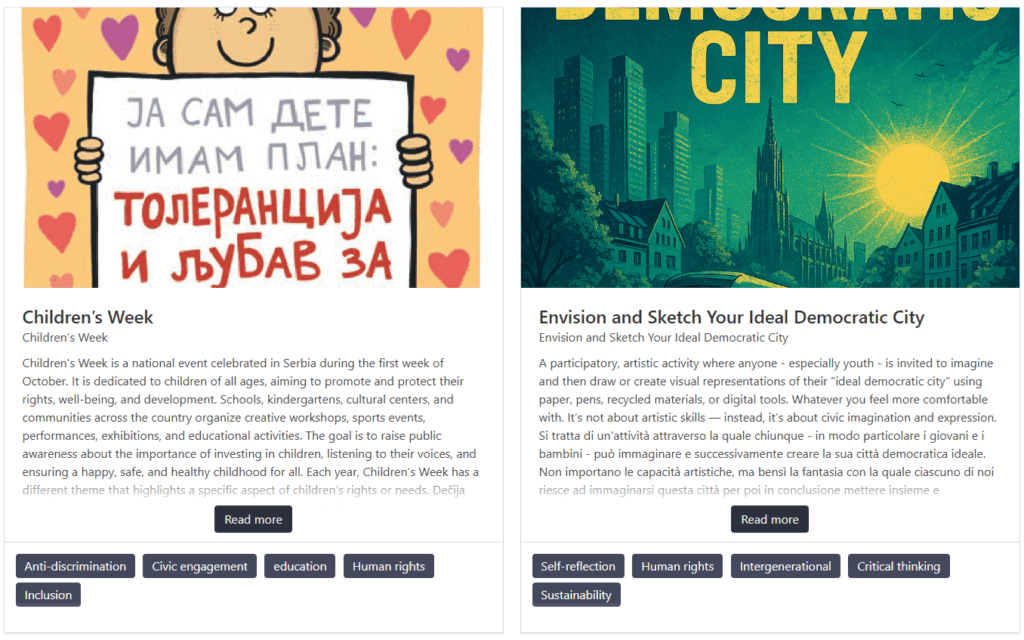
Dear colleagues and friends from the Danube region and other European countries, as part of the Fit4Democracy project, we are creating a so called “toolbox”: We will collect simple, everyday activities that help people participate in democracy. These activities should be easy to do, don’t require much time or money, and connect to participatory democracy. We are looking for successful practice examples you have been a part of from different countries that contribute to strengthening democracy. These examples should serve as inspiration to implement in your own context and to encourage the development of new ideas. The primary target group is not administrative bodies, political or business representatives, professional associations, but the citizens themselves (although they may act as supporting local partners in many initiatives)! Many activities in this area have already been implemented to promote democracy, but there are many others that are well suited for this context and not yet on our list – we are looking for them! We therefore invite you to support us with your own ideas – reflect, what example you know and what you could contribute to our toolbox. You can then submit these ideas you would like to share with others via an online form with a suitable picture. To submit we kindly ask you the fill out the following form: https://www.umfrageonline.com/c/vkrc7v94 The submissions will be checked by ILEU to ensure that they meet the requirements (clear reference to the topic of participatory democracy, easy to do, don’t require much time or money). We will then enter the examples on our project website (to get inspired of what could be submitted you can also have a look at the examples we have already uploaded): https://toolbox.fit4democracy.eu/method/. The goal is to gather as many best practice examples as possible which can be accessed by all interested people. If you have questions / are unsure if your example fits you can contact us before filling out the form: democracy@ileu.net . If you would like to submit multiple examples, please fill out a new form for each one. Enclosed we send you the form as a pdf so you can have a look at what information is required before you start to fill out the form. The form is available in different languages (Note: these are automatic translations, if anything is unclear, please let us know) but if possible, please fill out the form in English. Thank you very much for your support! All the best in the name of the ILEU team
5. International Project Meeting: Sustainability Goals in my City, 27.05.25
Focusing on SDG 3: Good Health & Well-being and SDG 5: Gender Equality The fifth international meeting of the Actionbound project “Sustainability Goals in My City” brought together 17 participants from Ulm, Odesa, and Sofia. While only about half of the participants have been accommodated so far, collaboration and exchange flourished during the session. At the beginning of the meeting Amelie from Lokale Agenda Ulm introduced the Actionbound platform, which will be used more independently by the partner cities. From June 2nd, Odesa and Sofia will receive their own accounts. Besides that, it was emphasized that future use of Actionbound should be kept under 1.5 hours to maintain focus and engagement. For any further questions, please contact: a.kruegler@gmx.de. Ulm: Inclusive Cafés and Sustainable Infrastructure SDG 13 – Climate Action: Smart Circular Bridge As a follow-up from Ulm on SDG 13, the city highlighted the innovative Smart Circular Bridge, which is constructed using fully recyclable materials. This sustainable infrastructure: SDG 10 – Reduced Inequalities: Café Blau Ulm also presented Café Blau, a prime example of local inclusion: SDG 3 – Good Health & Well-being: Kneipp Facility on Blauinsel A Kneipp water therapy facility on Blauinsel promotes health and fitness. Students were asked what they do to stay healthy. Their answers included: Odesa: Empowerment, Health, and Inclusion SDG 5 – Gender Equality: Vona Hub Odesa’s Vona Hub is at the forefront of promoting gender equality through: SDG 3 – Good Health & Well-being: Alternativa Founded in 2005, the Alternativa organization supports people affected by HIV. Its work includes: Sofia: Health Systems and Equality Progress SDG 3 – Good Health & Well-being: Medical Innovation and Accessibility Sofia presented an impressive overview of its health infrastructure: SDG 5 – Gender Equality: National and Local Progress Sofia addressed multiple aspects of gender equality: Looking Ahead The next digital meeting will take place on 23 June 2025, Let us continue our collaboration and commitment to the Sustainable Development Goals across borders and communities. Presentations Odesa Sofia Ulm
4. International Project Meeting: Sustainability Goals in my City, 29.04.254.International Meeting
Focusing on SDG 10: Reduced Inequalities & SDG 13: Climate Action The fourth international meeting of the Actionbound project “Sustainability Goals in My City” turned its attention to Reduced Inequalities (SDG 10) and Climate Action (SDG 13). Although students from Ulm were unable to join live due to illness, they remained involved digitally as groups from Odesa and Sofia shared insightful examples from their cities. Odesa: Striving for Inclusion Amidst Crisis The Ukrainian group focused on how Odesa is working to become a more inclusive city despite the immense challenges brought on by the war. To address SDG 10, they presented several ongoing initiatives: These actions reflect the urgent need to support people living with war-related injuries and disabilities. A recent feature by Deutschlandfunk sheds further light on this topic and was shared as part of the discussion:🔗 “Kriegsversehrte in Odessa” – Deutschlandfunk In comparison, participants noted that similar efforts exist in Germany, where cities also focus on barrier-free environments, inclusive education, and equal access to services. A Green Oasis in the Heart of Odesa For SDG 13, the Ukrainian group introduced the Botanical Garden of the Mechnikov National University. As one of the oldest scientific institutions in the city, it plays a crucial role in: Founded officially in 1842, and moved to the French Boulevard in 1880, the garden features many tropical and subtropical species and offers free entry, making it accessible to all citizens. Participants drew comparisons to botanical gardens in Germany, which often include medicinal plant collections and provide similar educational and conservation functions. Sofia: Welcoming Refugees and Building a Greener Future The Bulgarian group focused on two examples that illustrate Sofia’s engagement with SDG 10 and SDG 13. Under SDG 10, they presented the work of the State Refugee Agency (DAB-MS). Established in the 1990s, the agency coordinates: Participants highlighted how the agency works closely with governmental bodies and NGOs to foster inclusion and dignity for newcomers. For SDG 13, Sofia stood out as one of the greenest capitals in Europe. Efforts include: In contrast, participants observed that while Odesa has a well-used public transport system, bicycle lanes and pedestrian infrastructure are still limited, making Sofia’s achievements particularly noteworthy. The next digital meeting will take place on May 27, 2025, focusing on two new goals:Good Health and Well-being (SDG 3) and Gender Equality (SDG 5). Presentations Odesa Sofia Ulm
Chat GPT and Perplexity Qualification – Getting fit with AI
We extended a cordial invitation to our online training course “Introduction to Chat GPT” which took place on Monday, 28 April 2025, at 6:00 p.m. (CET). In this course, our colleague Gabriele Flemming explained the basics of using Chat GPT, a tool supported by artificial intelligence that could assist with many tasks—such as answering questions, translating, writing texts, learning, programming, and more. The course included information on how to use Chat GPT (e.g., how to create an account, the features of the free version, and the options and costs of the Pro version). It also covered ways it could be used in line with our project goals—such as researching participation opportunities, creating templates for letters, and translation. Additionally, the session provided information on possible alternatives to Chat GPT, such as Perplexity.